
The UK government has condemned violence in Bangladesh and called for peaceful elections after reports of killings of Hindus and other religious minorities. Concerns were raised in the House of Commons, with calls for UK intervention to protect minorities.

India expresses concern over the treatment of minorities in Bangladesh, condemning violence and calling for justice. They also address the return of a BNP leader and reiterate support for free and fair elections.

'Should China's interest in the Teesta River projects be approved, it would likely result in heightened Chinese presence near the Siliguri corridor.'

Bangladesh will hold general elections on February 12, 2026, the first since the ouster of the Sheikh Hasina-led Awami League government. A referendum on reform proposals will be held simultaneously.
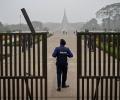
Bangladesh Nationalist Party (BNP) acting chairman Tarique Rahman visited Dhaka University and offered prayers at the grave of slain student leader Sharif Osman Hadi amid heavy security. He also offered prayers at the grave of Bangladesh's national poet Kazi Nazrul Islam.

Bangladesh's newly-elected Prime Minister Tarique Rahman pledged to strengthen the rule of law and ensure the country is a safe land for people of all faiths, while also addressing corruption and improving law and order.

Lok Sabha Speaker Om Birla will represent India at the swearing-in ceremony of Bangladesh's next prime minister, Tarique Rahman. Foreign Secretary Vikram Misri and Secretary-General of Lok Sabha Utpal Kumar Singh are also likely to accompany Birla.
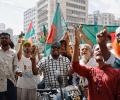
Bangladesh is preparing for elections and a referendum on reforms, but the absence of the Awami League and rising political tensions are raising concerns about the legitimacy and stability of the process.

Tarique Rahman was sworn in as Bangladesh's new prime minister following the Bangladesh Nationalist Party's landslide victory in the national elections. The swearing-in ceremony, administered by President Mohammed Shahabuddin, took place at the south plaza of the parliament building in Dhaka on Tuesday, February 17, 2026, evening.
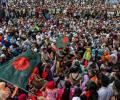
A key leader of Bangladesh's National Citizen Party (NCP), Mahfuz Alam, has distanced himself from the party's alliance with Jamaat-e-Islami, citing ideological differences and concerns over Jamaat's controversial history.

Following the BNP's victory in recent elections, Bangladesh is seeking to reset its relationship with India, emphasizing mutual benefit and a recognition of the changed political landscape.

Sarjis Alam, chief organiser of the NCP for the northern region, alleged that attacks occurred at more than 30 locations involving the homes and business establishments of party leaders and activists after the results were declared.

Tarique Rahman, after 17 years in self-exile, has led the Bangladesh Nationalist Party (BNP) to a significant victory, becoming the country's Prime Minister. This marks a major turnaround for the BNP after years of being targeted by the Awami League government.

Bangladesh's interim government has called on India to extradite Sheikh Hasina after she was sentenced to death in absentia. The move has sparked reactions from various political parties.

Bangladesh's interim government has ordered a nationwide security clampdown following the shooting of a youth leader and election candidate, leading to renewed unrest.

A referendum on the implementation of a reform package in Bangladesh saw a 60.26 per cent voter turnout, with the 'yes' vote winning a clear majority, the Election Commission announced.

Lok Sabha Speaker Om Birla attended the swearing-in ceremony of Bangladesh's new Prime Minister Tarique Rahman in Dhaka, conveying India's support for Bangladesh's democratic and progressive development and extending an invitation from PM Modi to visit India.
BNP chairman Tarique Rahman called for maintaining law and order and sought cooperation in building a safe and humane Bangladesh after his party's victory in parliamentary elections.

Khaleda Zia, the former Prime Minister of Bangladesh and a dominant figure in the country's politics, has died at the age of 80 after a prolonged illness. Her career spanned decades and included periods of both power and controversy.

External Affairs Minister S Jaishankar conveyed the condolences of the people of India and the government to Tarique Rahman, Khaleda Zia's elder son.
Now, in exile in India, Hasina, often dubbed the 'Iron Lady' of Bangladesh, watches from across the border as the nation she helped build, and often ruled with a firm hand, grapples with the legacy her rise and fall has left behind.

Former Bangladesh Prime Minister Khaleda Zia is in an 'extremely critical' condition, according to her personal physician. She has been hospitalized since November 23 for multiple health complications and is currently on ventilator support.

The Bangladesh Nationalist Party (BNP) has reiterated its demand for the extradition of former Prime Minister Sheikh Hasina from India to face trial in Bangladesh, emphasizing the need for equal and respectful relations with all neighboring countries.
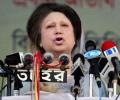
Khaleda Zia, Bangladesh's former first female prime minister and chairperson of the Bangladesh Nationalist Party, has died at the age of 80 after a prolonged illness.

The funeral prayer for former Bangladesh Prime Minister Khaleda Zia will be held on Wednesday in Dhaka. Foreign dignitaries are expected to attend.

'Many senior Bangladeshis feel Bangladesh will fall into anarchy if the Jamaat becomes an important part of a future government or has disproportionate influence in the government.'
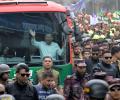
Bangladesh Nationalist Party (BNP) acting chairman Tarique Rahman has returned to Dhaka after 17 years in self-exile in the UK, amid political instability following the killing of a youth leader. His return is significant as BNP emerges as a forerunner in the changed political landscape.

A crude bomb explosion in Dhaka, Bangladesh, resulted in one fatality. The incident occurred near the office of Liberation War veterans and is under investigation. It precedes the return of a prominent political figure after a long exile.

External Affairs Minister S Jaishankar handed over a letter from Prime Minister Narendra Modi to BNP leader Tarique Rahman, conveying condolences after the death of former Prime Minister Khaleda Zia. Jaishankar's visit comes amid existing tensions between India and Bangladesh.

Khaleda Zia, Bangladesh's first female prime minister and a central figure in the country's turbulent political landscape for more than three decades, died in Dhaka on Tuesday at the age of 80.

Highlighting the party's broader stance on international relations, he added, "Friends to all, malice to none."

Relations with India experienced a downturn during Yunus's tenure, while ties with Pakistan saw positive developments.

Captured in powerful images and unforgettable moments, 2025 emerged as a turning point in global affairs. These images tell the defining stories that shaped the world across continents.
India summoned the Bangladesh envoy to express strong concerns over extremist elements planning to create a security situation around the Indian mission in Dhaka.

Bangla Inside Story: Players kept mum in-front of Nazrul, BCB's annual income could dwindle by 60%
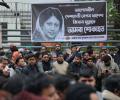
The funeral of Bangladesh's former prime minister Khaleda Zia will be held on Wednesday, and she will be buried with full state honors beside her husband, late president Ziaur Rahman.

'The real fault line in Assam is not Hindu versus Muslim. It is Assamese versus Bengali -- and within that, the specific anxiety about undocumented Bangladeshi settlers claiming land and altering the demographic balance of the state.'

Hopefully, the BJP will realise that it's the right time for parivartan (change) in its polarising poll strategies after achieving the impossible-looking goal of winning West Bengal, argues Sheela Bhatt.

Bangladesh's Chief Adviser Muhammad Yunus announced that the next general election will be held in February 2026, marking the first anniversary of the 'July Uprising'.
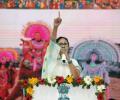
The BJP's West Bengal unit chief, Samik Bhattacharya, criticised the Trinamool Congress (TMC) government, accusing it of crushing democracy and fostering lawlessness in the state. He highlighted alleged political violence, economic decline, and disrespect for constitutional posts under the TMC's rule.
